
Post-predicate Elements in Iranian: Inheritance, Contact, and Information Structure
Funded by the Alexander-von-Humboldt-Stiftung
Funding period: 01.07.2019–31.03.2023
PI's: Geoffrey Haig (Bamberg); Mohammad Rasekh-Mahand (Hamedan)
International Workshop, 22-23rd September 2022
Post-predicate elements across the languages of Western Asia: theoretical and empirical approaches
Institute for Oriental Studies, University of Bamberg
This workshop brings together researchers working on several language phyla in Western Asia, who have been contributing data to the WOWA data bank (Word Order in Western Asia).
The WOWA compilers will present case-studies drawing on the entire data set, and external participants have an opportunity to present their own case studies from specific languages and language groups. We will also coordinate and organize the edited volume that has been commissioned to showcase the results of the project.
Research and the workshop has been funded by the project Post-predicate elements in Iranian and neighbouring languages, funded by the Alexander von Humboldt Foundation. We also gratefully acknowledge the support of the Elite Network of Bavaria for the workshop.

Attendance: The workshop is open to interested persons; if you intend to participate, please send an email with your name and address to admin.aspra@uni-bamberg.de
Programme: can be found here(111.6 KB) (111.6 KB).
Organizers: Geoffrey Haig, Mohammad Rasekh-Mahand, Laurentia Schreiber, Nils Schiborr.
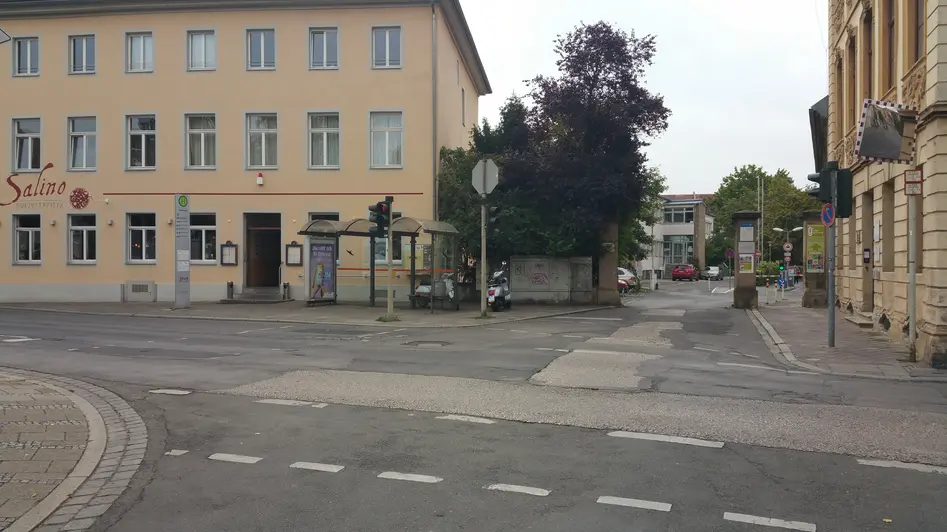
How to get to the institute: The institute for Oriental Studies is in the building Schillerplatz 17, but it is a little hard to find. When you are in Schillerplatz, look for the Italian restaurant Salino at one end of the square. To the left of it there is a bus stop and further left there is an entry, leading to a parking lot. Just behind that parking lot you'll see a rather new white building. That's Schillerplatz 17. The picture shows the mentioned entry.
Project background

Iranian languages are routinely classified as "verb final". While this is true with regard to the position of (non-pronominal) direct objects, which are generally pre-verbal, in several West Iranian languages, certain other constituents occur more or less systematically after the verb. The result is a typologically unusual and hitherto largely ignored OVX word order type within West Iranian. Furthermore, OVX word order has been identified in unrelated languages in contact with Iranian, including Turkic, and Neo-Aramaic.
Click here(251.3 KB, 13 Seiten) for the position paper.
This project brings together leading international experts on Iranian and neighbouring languages in order to explore
- the extent of OVX word order within Iranian, and its genesis within the family
- the areal spread of OVX word order in neighbouring languages, and the pathways of transmission
- information-structural correlates of OVX word order
- typological implications of OVX word order.
The Word Order in Western Asia Corpus
Datasets from the project are successively uploaded to this website, where they are available for quantitative analysis. Data sets include minimally a spreadsheet with coded data and metadata; most data sets also include the source texts (e.g. as PDF) and sound files.
The HamBam Corpus (Hamedan-Bamberg Corpus of Contemporary Spoken Persian)
Issues of information structure are primarily investigated using a corpus of contemporary spoken Persian, which is currently being jointly compiled at Hamedan and Bamberg. Results are available here. The architecture of the corpus largely follows the design implemented in Multi-CAST.
Workshop series
The associated scholars meet once a year for three years, with the aim of producing a multi-lingual survey of post-predicate structures across Iranian and neighbouring languages. Click here for the first workshop (Bamberg 6-7th September 2019)